ARS Connect Court Kiosks at Government facilities and Courthouses
Court Check-In Kiosk News — AI kiosk technology powers customer service check-in kiosks at government buildings
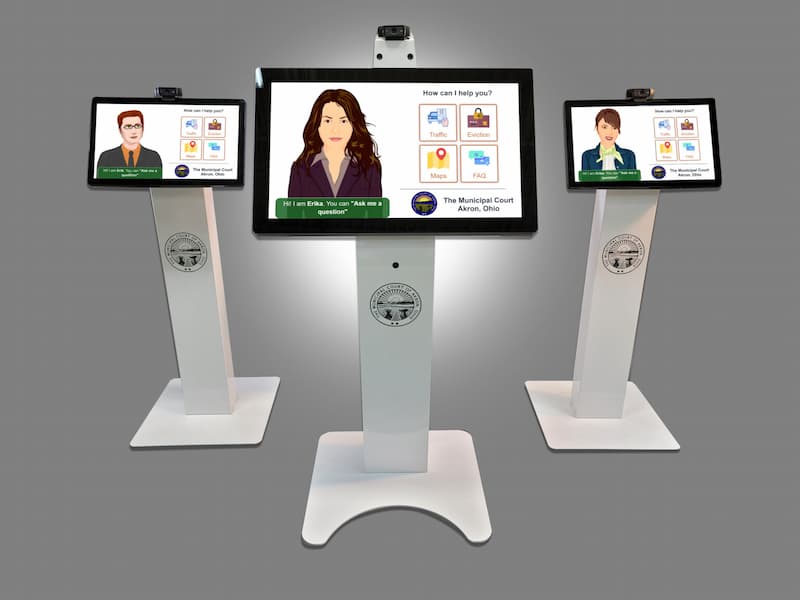
Court Kiosk – AI Kiosks
ARS Connect, the technology company behind a new, state-of-the-art AI kiosk workforce platform, partnered with Frank Mayer and Associates, Inc. on a self-service court kiosk solution aimed at courts, government facilities, and businesses. The court kiosk’s innovative technology provides customizable customer support for visitors, defendants and plantiffs, answering frequently asked questions like how to pay a parking ticket or where to go for jury duty.
- For lobbies and wayfinding
- Court hearing check-in
- Forms, payment, traffic, eviction, etc.
- Answers 100s of FAQ’s
- Multi-lingual and interpretation
- Deploy offsite too, e.g. library
- Connects to remote live telepresence help
When it comes to communication, for over 10,000 years, we as humans, want eye contact, body language, non-verbal signals like smiles and head tilts. When we communicate these small cues are built into our DNA. This is what ARS Connect’s A.I. avatar kiosk platform delivers! A real-time connection between Court/Institution and the constituents you serve. Simple touch-screen kiosks are a thing of the past, the future is here, engaging kiosks that talk, are friendly, helpful, and now, in response to COVID-19, are touch and TOUCHLESS!
Save Money and Serve Visitors Better
Our court kiosks solve one of the biggest problems municipalities and businesses have, staffing. They either can’t find or afford this type of help, and when they do, 30% to 50% quit. ARS Connect kiosks never call in sick, are always friendly, save your organization money, and provide amazing service. Not only that, but the data they collect can help you deliver better service and experiences for those you serve.
More Information on Court Kiosks
Some history on Talking Kiosks
MTA Chairman E. Virgil Conway today led the unveiling ceremony marking the installation of Penn Station’s new “Talking Kiosk.” Joining him were MTA Long Island Rail Road President Tom Prendergast and Jane Crotty, Director of Community Relations and Economic Development for Baruch College.
Designed for easy use and offering way-finding information to help a blind or visually impaired traveler navigate the station, the kiosk will be permanently installed in the LIRR terminal at Penn Station.
The “Talking Kiosk” combines a tactile and large-print map of the station with a talking computer that responds when points on the map are pressed. By following simple instructions, customers can be directed to LIRR ticket windows, track locations, MTA New York City Transit subway lines, MTA Police Headquarters, restrooms, and other important passenger services. It also gives directions to Amtrak and New Jersey Transit services at Penn Station.
The MTA and LIRR provided funding for the “Talking Kiosk,” which was originally piloted for five months in 1996 with information focusing on LIRR. It was developed at the Baruch Center for the Visually Impaired in collaboration with the American Foundation for the Blind and the Stein Partnership, and with assistance from the U.S. Department of Transportation, the Federal Transit Administration, and Project ACTION of the National Easter Seal Society.